Sunday, March 27, 2016

JHARGRAM DIARIES


Jhargram is very close to my heart and with a good reason. This quaint little town had cast it’s charm on me long time back in 2001 when I had for the first time set my foot here. This is one of the gateways to Jangal Mahal. The soil turns red and the majestic green cover of Sal, Piyal & Mahua starts here and then spreads on to the rolling landscape of Jharkahnd across the mighty Dalma range.

Back it 2001 I read an article in The Telegraph, beautifully penned by actor and author Barun Chanda, about Jhargram and how he was enchanted by its beauty. He also wrote about this place called ‘Salboni Retreat’ which was hunting lodge of the erstwhile Kings of Jhargram. The main palace of the Kings can be found at Jhargram town which has now been converted into a heritage stay and run by tourism department of West Bengal Govt.

It’s a beautiful property, about 10km off Jhargram town, right on the Lodhashuli Jhargram road, which is branching off from the NH6. It’s literally a small forest of 11 acres. This hunting lodge is now converted into a resort now, or should I correct myself, it’s not actually a resort. The word ‘resort’ conjures up am image of beautiful villas amidst carefully set landscapes with swimming pools, spa and all other goodies needed for good life but this is a far cry from it. A home stay would be a more apt description, bare basic and rustic. There are no televisions or air-conditioning. All you get is a rudimentary stay arrangement, but you have the nature to yourself. All you will hear is the whistle of wind through the tree leaves and chirping of birds as you laze away on the hammock strung between two trunks of Sal tree. Nights are silent and beautiful, hardly any artificial light & noise intruding your senses. So if you are ready to sacrifice a bit on the creature comforts you get to taste a different life, uncomplicated, pure and close to the nature. This place is owned and run by Bhaskar Dasgupta, a through gentleman and a wonderful host. Every time I stayed here I had experienced the warmest hospitality & care. The food was to die for and the tribal lady from the nearby village was an outstanding cook. No fancy stuff though, the food was just as humble as the ambiance of the place. Simple Bengali food, absolutely like home cooked, nothing more, nothing less and finger licking good.

I was in love the first time I was here back in 2001. Since then I was hooked and I came back here quite a few times till 2005. After 2005 the whole area was literally ravaged with severe insurgency problem making it inaccessible to the tourists. But Jhargram was always in my mind. Every time I was travelling to a the train would pass Jhargram station I would vow to come back here soon.

I was craving for a break and planning for a moderately long ride on my motorcycle was on the anvil. My friend Gautam proposed a day ride on March 20th which was a Sunday and I was more than eager to do it. Winter is already gone and summer was setting in. Soon the fierce heat would make it impossible to enjoy long motorcycle rides. So I decided on Jhargram. Just 176kms away from Kolkata it is a perfect destination for a day ride. I called up Mr. Dasgupta and booked a room for us for the day.

The Startoff

We planned to start at 6am. I met Gautam in front of Mahajati Sadan who was waiting with his Royal Enfield. Soon we were rolling, crossed Vidyasagar Setu and then onto the wide NH-6 through Kona Expressway. The ride was great on the six lane highway till Kharagpur with only a tea break at Kolaghat. We made good speed and then beyond Kharagpur we continued on the NH-6 but now it had become a single lane. However to our delight the surfacing was good, with nary a pothole in sight. We maintained decent pace but it was time to soak in the beauty of the landscape. The lush green fields gave away to red soil and we could see thick line of trees in the distance. Then the forests drew near, shining green leaves of young Sal trees greeted us. The undulated road twisted and turned through the forested landscape. We reached Lodhashuli crossing from where we took a right and took the road leading to Jhargram. This road is also beautiful, lined with trees on both sides making the drive a very pleasant one. However I remember back in 2001 this road was a dangerous place due to poor law & order situation. Armed robberies were frequent in those days and the whole stretch of road from Lodhashuli crossing to Jhargram town was notorious for this. So much so that movement of vehicular traffic was restricted by police after dark. I still remember that in those days cars used to move in convoy after dark lead by a police escort vehicle. Today these are like distant bad dreams and now you can move freely and without worries at any time. 


That's us waiting at the main entrance of salboni Retreat. The main building is long way off and the gate was locked and there was no way to communicate our arrival other than calling up Mr. Dasgupta. So we had to wait for few minutes till the attendant walked down the long trail to the main gate

We had a warm welcome and Mr. Dasgupta personally came to meet us. We were escorted to our first floor room at 'Durgabari'. This is a rather uniquely designed house, very simplistic architecture but designed to effortlessly into the atmosphere of the place.


This beautiful but rustic two storied building houses four rooms on each floor. This wasn’t there in the beginning but was built sometime in 2002. I love the room upstairs with a view of the forested compound. The veranda is simply a great place to spent a lazy evening. And Oh yes… sometimes Elephants from Dalma do pay visit inside the compound.


This is the view from the balcony of our room on the first floor. Our bikes parked. The last few times I was here I was always worried about wild elephants breaking in the compound and try some football with our parked car.


Again it was narrow but perfectly laid out metal roads running through forest, a far cry from our earlier experience of broken roads posing serious threat to car’s suspension. Our first target was to reach Chilkigarh Palace and then pay a visit to Kanakdurga Temple on our way back.


We had to cross river Dulung on our way to the palace. We stopped by on the concrete bridge on the river.


Sadly the river looked almost like a dirty nullah. With stagnant dirty water in which people and cattle bathing it was hardly a great sight. However post winter and the summer setting in, the river doesn't get much water and thus this situation. Dulung is at it's best during monsoons when there is a angry rush of water from the heights of Dalma range. 

About 200 meters from the bridge the main entrance of the Chilkigarh palace loomed large.


Once inside through the brick archway there is a huge compound and the palace can be seen straight down at the end. On the left there is an outhouse with pillered front adorning a large veranda. 


As you enter through the main gate there is a clock tower on your left beside an ancient banyan tree. Directly opposite the clock tower there is temple compound which house the family deity of the Dhavaldevas, the royal family of Chilkigarh. 


The royal family doesn't live here though. I could see that the building now houses Govt. offices.


The Royal family of Chilkigarh was a great patron of ‘Chilkigarh Chou dance’. This was unique and quite different from the Chou form as can be seen in Purulia or Seraikela. This particular dance form is also includes mimicking various gods & goddesses, animals and common people. It was something like role play and was often performed with wooden dolls in hand. This Chou dance form had use of masks but not on all types of dance recitals and the masks were nowhere near to the elaborate head gear of the dancers which is normally associated with Purulia or Seraikela Chou. It was more simplistic and did not have the aggressive war like stepping and movements. Rather it found it roots in the simplistic way of life of the tribals who still dominate this area. The dances played 'Ganesha' the elephant god, 'Ravana' or the demon king, or mimicked human charecters like 'Babu' (a affluent gentleman known for his exuberant ways)or 'Tanti', the weaver etc. This art form had made it’s distinct identity as a specific branch of Chou dance called ‘Chilkigarh Chou’. The biggest event of Chou dance used to be held during the 'Gazan' a festival linked to lord Shiva and widely celebrated all across Bengal on the last day of Bengali new near in the month of 'Chaitra'. Sadly with the fall of the Dhavaldevas, this dance form did not find many patrons and is now almost extinct.


This is the front view of the palace. I was told that the members of the Royal family now stay in Kolkata.

The next stop was the Kanak Durga Temple, and the deity was also worshipped by the Royal Family of Chilkigarh.


The temple also got a neat makeover. Earlier there was a narrow trail branching out of the main road which ran upto the temple compound, amidst dense shrubs and the foliage overhead forming a tunnel like path. It was a narrow trail, just about adequate for a car to pass by and leaves would brush against the body of car and branches of the trees would invade through open windows as one would carefully negotiate the bends of the narrow trail of red earth. Now it’s different. Cars are no longer allowed to the main temple complex. There is a paid parking lot which has come up. One needs to park the car there and cover the rest of the distance on foot. But also gone are the trail and the thick green cover which earlier gave you a spooky feeling. It’s a concrete pathway now, and shrubs and trees are cleared on both side giving you a feeling of entering a carefully maintained park. And indeed it was. I could see well maintained gardens and children’s park and toilets. The compound got a clean and sanitized look and the temple received a fresh coat of paint. But what is lost is that distinct eerie feeling one would get while entering the temple here. It used go so well with the stories that the tantric cult was followed here and also human sacrifices were made regularly at this temple in ancient times. Call it the effect of urbanization but while the amenities and convenience are growing, the charm is getting lost in the process.


The photo above is the front view of the temple. 


At the back ground the main temple can be seen. However this is not the original temple and was built at a later date. The ruins of the original temple can be seen on the left side of the new temple.


Kanak Durga Means Golden Durga. The small idol of Durga or Mahamaya is essentially in stone but now layered in gold and worshipped daily. I could not find much history of this temple but it is believed that this temple was built by King Gopinath, the descendant of King Jagatdeo who was forced in exile at this place after a rivalry.


The old temple in a dilapidated condition can be found standing on the left side of the new temple. This is about 30 ft high and built in the ‘Pancharatna style’. A huge crack is clearly visible right in the middle running from the top to the base which the locals say is the result of temple being struck by lightning. We took photos of it to document the present state as we are not sure how long it’s going to last given its present condition.


Sadly there is no effort from ASI to maintain & preserve the temple.


This is the ancient banyan tree. Typical to many temple sites in India here also people come make a wish before the Goddess and tie strings on the branches of the tree hoping it will be fulfilled.


Once done we started our way back to the resort. It was green all around and we were thoroughly enjoying the ride amidst the tranquil forest.


On our way back we came across this unique creation of nature.


While riding back we decided to take a detour. There were so many trails leading out from the metaled road and disappearing into thick forest. I always wanted to traverse these trails but could never do so due to paucity of time and the fact it could not be explored in a car. Motorcycles are perfect tools to explore these trails and we did not let go the opportunity.


This trail seemed to be perfect and rode deep into the forest. We did have some off-roading experience negotiating the rugged earth but it was sure hell of fun.


I noticed a largish ant hill and I parked beside it.


It was green cover all around, preventing the rays of fierce midday sun and casting a soft glow on the forest floor. We shut off the bike’s engines and just stood there, soaking in the sights and sounds of the forest.


It was so peaceful we felt that as if we have been transported to a different world altogether. The half an hour we spent there was almost therapeutic.


Now it was time to return to the resort, have lunch and start our return journey. We came back and spent a leisurely one hour and went for a late lunch.

Now the lunch was a grand affair, not that we were treated with gourmet cuisine. This was a pure Bengali Sunday lunch of Bhat, Dal & Mangsho (Goat Meat). The lady from the nearby village isn’t just a cook but a culinary artist. The travel is well worth just to have lunch or dinner made by  her. There was this delicious chicken chop and the meat preparation was out of the world. I am in love with the meat which is served at  Banalaxmi near Shantiniketan but this one is a worthy competitor. We also had ‘Kancha Aam  er Chatni’ and the mangoes came from the trees of the resort. 

Photo courtesy :  Blogpost  of  Salboni  Retreat

Mr. Dasgupta made it a point to sit with and supervise our lunch which is so heart-warming. You feel that you are visiting home of somebody very close to you. This is rare these days and this is exactly what makes me come back here again & again. This is something which money can’t buy.    

So it was time to bid goodbye. I wish this was a longer trip and a night stay would have been apt but nevertheless, it was indeed an exhilarating experience for both of us.

HOW TO REACH:
Jhargram is only about 180 kms away from Kolkata. It is best to come by  road if you have  your own vehicle. From Kolkata one needs to exit via Vidyasagar Setu and onto Kona Expressway leading to NH6. Once you hit NH 6 it’s  a straight drive through Kolaghat and Kharagpur till Lodhashuli crossing. From Lodhashuli, you need to turn right towards Jhargram. From Kona Expressway to Kharagpur it’s a four & six lane highway and you can maintain good pace. Kharagpur onwards the NH6 narrows down to single lane but in the month of March 2016, the surfacing was excellent.  Since from Khagarpur onwards it is not a toll road and not a part of Golden Quadrilateral, you may wish to find out the exact road condition before you undertake your journey. But this stretch is only about 30kms and generally in manageable condition even for small cars. At Kharagpur you need to be careful to take the left flank of the highway going past Kharagpur town and beyond. Look up for a roadsign indicating Kharagpur to your left. If you drive straight you will be headed towards Odisha via NH-5. This road continues as six lane and many people erroneously take this straight road instead of taking the left flank.


There are regular train services between Howrah & Jhargram.

Howrah to Jhargram:

Jhargram to Howrah:

WHERE TO STAY:

Salboni Retreat :
Garh Salboni, Jhargram, Paschim Medinipur, W.B.
Mr.  Bhaskar Dasgupta
Phone : 9432 863167
*This  is on the Lodhashuli  -  Jhargram Road on your left. Try to stay at Durgabari, on the first floor. Those are the best rooms. There is  no AC or Television.

Aranya Sundari Guest House
Sibasis Chatterjee
Jail Khana More, Ghoradhara, Jhargram, Paschim Medinipur, W.B.
Phone: +91-3221-256872 | Mob: +91-9547668966.

Doolung Guest House
Arindam Acharya
Near Hindi School, Ghoradhara, Jhargram, West Bengal 721507
Ghoradhara, Jhargram, Paschim Medinipur, W.B.
Phone: 096144 69131 / 03221-255909

ESHANI Guest House
Atanu Das
Natundihi (Near Local Board), Jhargram, Paschim Medinipur, W.B.
Mob: +91-9733736372, 9232772761, 8016103128 

Jasoda Bhawan Guest House
Central Bus Stand, Jhargram, Paschim Medinipur, W.B.
Phone: +91-03221-255225
Mob: +91-9163141340
9800055195 (Emergency)

Kaushalya Heritage
Garh Salboni, Jhargram, Paschim Medinipur, W.B.
9830634541 / 9874815102
* Contrary to the name it's not a heritage  property. It's just a guesthouse beside Salboni Retreat

Banani Atithi Nibas
Kadam Kanan, Jhargram
Paschim Medinipur
Ph: 03221-257945

The Palace Resort
Jhargram Raj Palace, Jhargram, Paschim Medinipur, W.B.
Phone: +91-3221-255401 | Mob: +91-9635269416
*This one, is  by far is the most luxurious stay option. This is a heritage property and the palace of the royal family of Jhargram. The property is now managed by WBTDCL.

Jhargram Prokriti Porjoton Kendro
Under WBFDCL
Old Jhargram (Bandorbhola), Beside Sree Ramkrishna Saradapith

Jhargram, Paschim Medinipur, W.B.


WHAT TO EAT:

All the hotels and lodges have restaurants and food arrangements. However if you are on a day trip there are eateries available at Jhargram town where you can have basic meal.

Tuesday, February 2, 2016

THE BLUE LASSI SHOP, VARANASI


I was told that a visit to Varanasi will be incomplete without tasting lassi from the “Blue Lassi Shop”.

Now this is a land of lassi, practically at every street corner there is a shop selling lassi and rabri of amazing quality. I had tasted both from some of the revered shops like the Pagal Sardar Lassi shop at Vishwanath Galli and a couple of places near Godhuliya Chowk. Yet a visit to the ‘Blue Lassi’ shop was the order of the day to complete the cycle of karma of drinking lassi in the holy city. Blue Lassi shop is unique and it stands out from the rest, that was the briefing given to me and I was quite eager as not to miss out even if I had to bend few of my schedules.

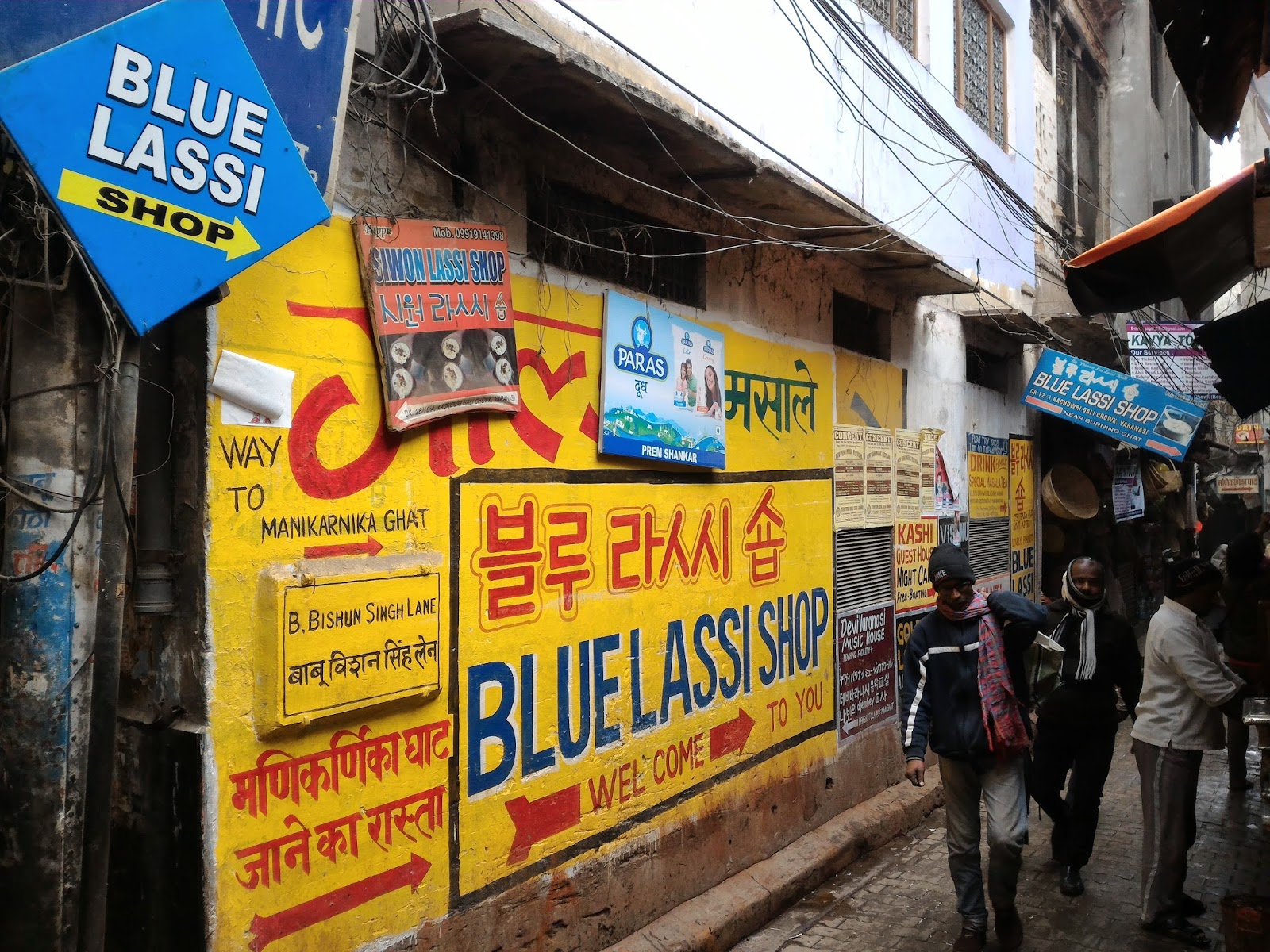
Tucked away on a narrow serpentine lane branching out from the famous Kachouri Galli, and leading towards the Manikarnika Ghat, it’s almost impossible to locate the shop, had it not been for the bright paintings on the wall in blue and yellow announcing it’s existence. It’s not very far from the epicenter of Varanasi, the Godhuliya Chowk, and it’s less than 10 minutes walk from there.


The first look at the shop was rather jolting for me, as the size of the shop is nowhere near the size of reputation that precedes it. It’s a small place, with an open front where the ubiquitous steel jug and wooden stirrers are kept along with the large earthen pots containing the curd. Just beside the open space there is a low doorway to enter the shop. I tucked my head in and went into the dimly lit interior. It had no window, excepting a curtained door at the back, which I presume leads to the living quarters of the house. Even in the broad daylight it was almost dark inside and I started taking a better look as my vision slowly started getting adjusted to the darkness. True to the name the walls were painted in shade of blue, bordering on Garish, and also deep shades of green along with motifs and faces of Gods & Goddesses. But the most interesting part is the thousands of small stamp sized photos and small paper chits along with it that are pasted all over the four walls. This is an amazing array and basically these are photos of people who had visited this shop and liked their lassi. They have a custom of collecting the photos. If you like their lassi you can also share your photo which will be put up on the wall. You can also leave a small note of appreciation which will also be struck on the wall. So it was a mini world within those four walls of that small dark room. You get to see photos of people from around the world along with notes written in various languages starting from Indian languages to English, Spanish, French, German, Korean, Japanese and as far as from South American Countries. This gives you an immediate idea how popular this lassi shop is among foreigners visiting Varanasi. In fact while we were there all other customers were Europeans and a few from south east Asian countries.

 The interior of the shop with photos and notes from all over the world 

Message from Chile

In fact the there is a history attached to this shop including how this shop got it’s rather unusual name. Blue Lassi shop wasn’t ‘Blue’ even twenty years back. It was just a humble lassi shop probably known by the name of it’s owner. Some seventy five years back Pannalal Yadav, started the lassi shop on the ground floor of his house on the narrow lane leading to Manikarnika Ghat. It didn’t have any fanfare but honest to goodness quality which is being maintained till date. It was known as Pannalal Yadav’s lassi shop. Slowly the shop started gaining popularity and it was being frequented by the foreigners. Varanasi, being the holy city for Hindus and also a centre for Buddhism because of it’s proximity to Sarnath, is frequented by foreign tourists round the year and they found this shop to be a nice joint to hang out. Unlike other roadside shops in Varanasi, which also sells very good lassi, this shop has a small seating arrangement inside which could have found favour with them. May be it also had a locational advantage being right on the lane leading to famous Manikarnika Ghat. Anyway the business flourished and Pannalal Yadav had become quite a known name. There is a photograph of him hung on the rear wall of the shop. This gentleman was more than just a ‘lassiwala’ and even acted in few movies. Vijay Yadav, his son and the current owner tells us about his father’s dabbling with movies and there is a Bengali connection. His first stint before the camera was with none other than the maestro Satyajit Ray, while he was shooting ‘Joy Baba Felunath’ at Varanasi. Pannalal Yadav acted as a villain in the gang of notorious crimelord ‘Maganlal Meghraj’ made immortal by Utpal Dutt. He had further acted in ‘Sant Tulsidas’ and the Sunny Deo starrer action movie ‘Ghayel’.

Vijay Yadav, whose picture you can see here, making lassi, joined the family business some 45 years back and I guess he was pretty young at that time. Since then he had been making lassi with his own hand maintaining the same legacy of quality. His son went to college and after getting his degree he also got involved in the family business. The change came some 20 years back when a team of Korean nationals who were obviously smitten by the quality of the lassi suggested that shop should be named ‘Blue Lassi Shop’. Do not ask me why this name, even Vijay Yadav is clueless. I take a wild guess that the interior of the shop would have been painted in blue, thus the name. Anyway it acted like a lucky charm and soon the name became very popular. So much so was the Korean influence that the name ‘Blue Lassi Shop’ is written in both English and Korean on the walls. Another important thing happened at the same time. Vijay Yadav’s son did some smart thinking and with steady experimentation brought variety to the humble lassi by adding fruits and flavors. This transformed the business further and the name spread quickly for the USP they were offering. Today they sell about 90 different types of flavored lassi. Most are punched with fresh seasonal fruits (a la natural ice cream)and flavours like chocolate & strawberry.

 Vijay Yadav busy preparing lassi

Now this is being poured for serving

Garnishing done. Cocoa powder being added for chocolate flavor

We had decided to try out different flavors and orders started with chocolate and punched with fruits like strawberry, apple, banana & shredded coconut. There is no machine involved it’s still hand churned with a wooden stirrer in an aluminium pot. The quality of the curd is outstanding and thick lassi that is produced literally need to be scooped out with spoon from the earthen cup in which they are served. One such portion, though looks small, can be quite filling and enough to douse the pangs of hunger. All the flavors, punched with fresh fruits, cocoa powders, strawberry flavors tasted great. We had lassi from other places in Varanasi but this one was unique experience.

 Almost ready for serving

 The seven different flavors in all their glory

Here is the close up view

The price is bit on the steeper side, an average flavoured lassi will set you back for more than sixty rupees. But the quality and taste more than make up for the price. You can see the handwritten chit in the photograph which was given to us a bill, and this will give you an idea of the prices.

The Bill.

The environment is also unique, while having lassi, you can see, hear and feel the throbbing , pulsating spirit of Varanasi all around you. The narrow lane, jostling crowd, interlaced with cycles, motorcycles, blaring horns, the cacophony and ubiquitous bulls & cows, all will overwhelm your senses. If you wait long enough you will hear the chanting of ‘Ram Nam Satya Hai’ and dead bodies will be carried past you towards the Manikarnika, the eternal burning ghat, as you are sipping your lassi.

This is something unique which can only be experienced in Varanasi, the oldest and holiest of them all. And yes Varanasi has grown on me in just two days. I will come back here and Blue Lassi Shop shall remain on my must visit list.

Sunday, January 17, 2016

JOYNAGAR ER MOA, NOLEN GUR AND MORE (জয়নগরের মোয়া, নলেন গুড় আর কিছু নেপত্থ্য কাহিনী)


Winter brings many pleasures in the life of us Bengalis, especially when it comes to gastronomical delights. Winter is also synonymous with “Nolen Gur” or the liquid date palm jaggery, the aromatic golden brown liquid which becomes part and parcel of Bengali must haves when the chill factor bites in. We have it straight, or use it to make Sandesh, Rosogolla, and again use this for preparation of innumerable varieties of Pithe and Payes during Sankranti . The list could be endless. In my opinion Nolen Gur with Fulko Luchi makes one irresistible combination guaranteed to make any Bengali go weak on his / her knees. Such is the magic of Nolen Gur that it makes itself an integral part of our life in this season. We embrace the Nolen Gur culture with vengeance as this pleasure is short lived and the best quality is produced only during the coldest days of the month which unfortunately are quite numbered here in Bengal. In recent days I have noticed ‘Nolen Gur’ being sold in a tube like tetra pack at the Biswa Bangla outlets and also at the Govt stalls at various fairs which pops up in and around Kolkata during winter months. I never had the chance to taste this but the few people I know who had tasted this, did not speak very highly about the quality. The attempt is of course to make this delicacy available round the year but apparently the process hasn’t been perfected as yet to retain the original magic. 


So our wet dream to sip on some fine Nolen Gur during the sweltering summer months isn’t a reality as yet. It’s available to us and best enjoyed only in winter. It’s the season when the date palm trees produce sap which is the base of everything.

Close on the heels of Nolen Gur comes another delicacy called “Moa”. If you just look around Kolkata & suburbs, just at the advent of winter, huge number of signboards pops up everywhere proudly announcing the availability of “ “ASOL JOYNAGAR ER MOA” (Authentic Moa from Joynagar). Every neighbourhood store would stock up with “Moa” and “Nolen Gur” apparently from Joynagar only. People in altogether different trade, would deck up the corner or the front of their shops and display the earthen pots of “Nolen Gur” and stack up the colourful paper boxes containing Moa. Much like the same way they would stock up on the fruit cakes during Christmas, or fire crackers during Diwali. All true blue Bengalis, would start hunting for Moa & Nolen Gur in this season. I am no exception and I am also out hunting for Gur and Moa at various city outlets and checking back with friends and relatives as to which are the joints selling the ‘authentic’ stuff from Joynagar. My love for Moa and Gur was seeded deep inside me during my childhood when an old man from Joynagar used to bring Moa and Gur to our Salt Lake house every season. And till date I remember the excellent taste. He continued to supply for quite a few years and then suddenly stopped coming. He was ill and not keeping good health and probably couldn’t take the rigors of travelling all the way from joynagar with the heavy merchandise. Probably he is no more, it’s all such a long time ago, I am not sure, but I missed the taste. Thereafter I had bought Nolen Gur and Moa from many places in Kolkata, some of them were excellent, some good and some plain bad. But I have understood over the years that the place “Joynagar” is an icon for Moa, entwined in such a manner that Joynagar & Moa are uttered in the same breath, something like ‘Darjeeling Tea’. The good news is that, just like Darjeeling tea, Geographical Indication (GI) had been awarded by Govt. Of India, for the “Joynagar Moa”, vide Geographical Indications Journal No. 61, Dated November 21, 2014 (Page 61 – 69). The area demarcated under the Geographical notification is Joynagar Block I and  II of the Joynagar Mazilpur Municipal area which is about 50 KMs from Kolkata.


This was initiated by “Joynagar Moa Nirmankari Society”, having their address at Radhaballavtala Road, Joynagar – 743338, South 24 Parganas, West Bengal, India. The Moa was classified in GI document as ‘Class 30” product under sweet meat category.  Now Joynagar Moa has also been given a specific logo which is used by producers indicating authenticity of the product. 

The Logo


This is a step in right direction and hopefully will go a long way to protect the standard and quality of Moa. The man behind “Joynagar Moa Nirmankari Society” is Mr. Ashok Kayal, who had taken interest in reviving the art of making Moa and enhance it’s marketability though branding & quality control. He had started producing & selling Moa under this brand and logo through various outlets and also through numerous fairs organized across Bengal. 


But this is a very recent initiative and it still has a long way to go to attain prominence. Also the problem is the abundance of fake ‘Joynagar Moa’ which is being sold everywhere in Kolkata and it’s getting almost impossible for the common people to get access to the ‘real thing’. Moa can be prepared by practically anybody and that’s exactly what is happening. Moa is being prepared in Nadia, North 24 Parganas or right here in Kolkata, but it’s failing to create the magic of the original from Joynagar. But everybody is using the words ‘Joynagar’ else Moa won’t sell. Deceitful traders are using chemical scent in lieu of high quality Nolen Gur and using Khoi from low grade rice and substandard ‘Khowa’ to make and sell Moa. These fake. Poor quality Moa are most often being sold in attractive packaging and flooding the market as authentic ‘Joynagar Moa’. Such is the level of prolificacy that the original is hugely overshadowed by fakes and days are not far when people will be made to believe that those are the originals.   Nothing could be done till date to stop abuse to this unique product and neither there is any government or judiciary intervention to make the brand safe and prevent duplicates being sold under the guise of authentic Joynagar Moya.


There are critical ingredients which go into the making of a fine Moa from Joynagar. These are raw materials which are specific to the geography of Joynagar and surrounding areas. Without these key ingredients a Moa doesn’t become a ‘Joynagar Moa’. This is much like the same as the waters from Scottish Highland which goes into making of finest single malts, or the combination of cold weather, mist and soil around Darjeeling hills that nourishes and produces tea leaf of unique quality & aroma. These can never be replicated elsewhere.

So readers, if you are wondering what goes into the making of Joynagar Moa, here are the basics.

The ingredients:
  • Khoi derived from Kanakchur paddy
  • Nolen gur or liquid date palm jaggery
  • Gawa Ghee (Clarified Butter made from cow milk)
  • Cardamom (Elaichi)
  • Khowa Kheer
  • Sugar
  • Dry grapes (Kismis)
  • Cashew nut for garnishing.
  • Pistachio crumb
  • Jaggery

The Khoi & the Nolen gur are the primary materials hence most critical. Khoi is produced from a specific species of aromatic paddy known as ‘Kanakchur’ and this is grown only in this region. The Moa is made only from the best quality Khoi. Also there is a concept of ‘Male & ‘Female” khoi which only the expert eyes can differentiate. The female khoi is identified by a fine slit on the body. It is stark white in colour and aromatic. If you take it just with milk and Nolen gur, it tastes amazing.

Finest 'Khoi' from Kanakchur Paddy at Srikrishna Mistanna Bhandar - Baharu 
(pic courtesy Joydip Maiti) 

Next of course is the Nolen Gur. Making the finest quality Nolen Gur is a heady mixture of fine art and science. The base is of course the sap from the date palm trees. The tapping for the sap requires very high level of precision. The sap or the juice is obtained by making a cone shaped incision on the trunk of the date palm tree, carefully leaving the terminal bud intact. At the base of the cone, a canal is cut around it, in which the juice oozing from the cone is collected and guided via a spout made of the leaf midrib into an (earthenware) jar, hung on the side of the palm. The cone is protected from the sun against drying out, by an inverted basket or by palm fiber. The juice slowly gets collected in the earthen pot and it’s is collected early in the morning, before the sunrise. This is critical and if this is delayed, as the day gets warm, the sucrose in the sap will break, triggering fermentation which sets in spontaneously by naturally occurring yeasts and within a day most of the sugar will have been converted into alcohol (around 5% v/v). The liquid will turn milky white. The raw juice is clear, bit pale, almost colourless, aromatic and has a beautiful sweet taste. To sip on a glass of freshly collected Date Palm juice early in the winter morning is an experience itself.

The Date Palm tree needs to be at least 10 years old to be fit for tapping. Thereafter with the correct tapping method a tree can yield sap for about 25 years, though higher productive life of 30+ years have been recorded. One tapping produces about 500 liters of sap in a season with 8 – 10 litres of sap per night. While the sap is being collected overnight on a regular basis, the terminal bud is growing upward also and every 20 days or so a readjustment of the cone, canal and spout implant has to be made.

Once the season is over the cut surface will dry out and heal, leaving an indent in the trunk. The next cut will be made on the other side of the trunk (180° ) a little higher because the palm has grown. Eventually after several years of tapping the trunk will assume a zig-zag configuration which is a common site in rural Bengal.

So the sap collection process is fairly complicated and requires serious expertise. It’s critical to make the incision in correct manner. A shoddily executed job will lead to early death of the tree. Improper incisions will either restrict the flow of juice or if the channel is not cut properly and the pot is not placed at the right spot, sap will go to waste. There are trained people who are doing this job through generations and their expertise is passed onto the next generation. These people who are doing this for generations are called ‘Shiuli’ and they are highly in demand, by businessmen taking lease of the trees  as good quality of date palm juice depends a lot on the expertise of the Shiuli.


The juice, immediately after collection, is sent for making it into ‘Nolen Gur’ or Date palm jaggery. The sap is boiled in large flat metal trays over clay ovens. Normally the dry date palm leaves or bundles of straw are used as fuel which is fed on one side of the stove and the smoke leaves from another or multiple holes. The end point of boiling which may take a couple of hours, is different for each of the intended products and usually recognized by the type of bubble which appears during boiling. Depending on the quality of the sap, the intended product is decided. For example the finest sap goes into making of Nolen Gur. The second best is used to make ‘Patali’, a hard form of jaggery, by making the sap further caramelized. In a rough estimate, to make one litre of Nolen Gur, almost ten litres of date palm sap is used. Once Nolen Gur is prepared, it is stored in earthen pots. Currently good quality Nolen gur is retailing between Rs.120/- & Rs.150/- a KG at Joynagar depending on supply (January 2016 pricing).

 Nolen Gur being prepared on an oven. Bundles of straw are being used to keep the fire going. 


See the long clay oven with multiple holes for the smoke to escape.

Now the ‘Khoi’ from Kanakchur dhan would be poured into the large iron oaks containing still warm Nolen gur and continuously stirred with a wooden ladle. When this mixture is cooled off, it’s used to make Moa. The artisans put pure ghee on their palms and with amazing dexterity gives the round shape to the Moa. Each Moa would weigh between 50 & 75 grams. While preparing, mixing of sugar, khowa, Cashewnuts, Cardamom, Ghee, and Dry grapes (kismis) are also added to enhance taste & flavour. However purists like Ashok Ghosh of Srikrishna Mistanna Bhander would not like the use of ‘Khowa’ as they believe garnishing with ‘Khowa’ somewhat overshadows the subtle taste of Nolen gur. However at Baharu, khowa is used without any qualms.

Nolen Gur being mixed with khoi at Shyamsuder Mistanna Bhandar - Baharu 
(Pic Courtesy ; Joydip Maiti) 


The mixture of gur and khoi being stirred.

The final product: Note the liberal anointing  of Ghee onto the hand while shaping the Moa.
(Pic courtesy: Joydip Maiti) 

However It’s not only about the pure and high quality ingredients, it’s also about the skill of the artisans which goes into making of quality Moa which melts in your mouth. The ability of choosing the best khoi, the secret recipe of boiling & mixing in right balance of jaggery with the khoi are passed over generations of the artisans.

This wondrous mixture of unique and localized ingredients and skill set of the artisans of Joynagar combined, had earned them the Geographical Indication.

So I wanted to get the ‘Moa’ and “Gur’ right from the birthplace. However in a rough estimate, during winters there are close to 150 shops in and around Joynagar selling Moa, and most of the shops are also temporary. Local people put them up during winter to cash in on the Moa frenzy. I had to seek out the best ones. After long days of serious research and consulting with many, including the locals from Joynagar I came to know about two shops, “Sri Krishna Mistanna Bhandar’ at Joynagar & ‘Shyamsundar Mistanna Bhandar’ at Baharu. It must be mentioned that my young friend Joydip Maiti did some painstaking research and gathered data as much as he could, got insights from lot of people, without which this article couldn’t have been penned down. Joydip was digging into the history, spoke to several people including Ashok Kayal of “Joynagar Moa Nirmankari Society”. His ancestral home is also near Joynagar, so some contacts there also helped. We planned to travel both to Baharu & Joynagar to see, taste and collect Moa & Nolen Gur. After long discussion we both agreed on visiting the above two shops. Accordingly Joydip got hold of phone numbers of both the shop owners, spoke to them at length, probing for details and told them about our visit. 

Now Baharu needs some introduction, for a fare reason. Joynagar shot to fame and it is said that Moa was created here and thus the name of the place got integral association with the product. Baharu falls under the Joynagar area only. The history and origin of Moa is quite hazy as there is hardly any documented history. It is after all a sweetmeat which was made and consumed by common men and never had the patronage of the kings and riches. Baharu also claim it’s fame being in close proximity to Joynagar (It’s just one stop ahead of Joynagar). In fact it has everything Joynagar has, right from high quality Nolen Gur, Khoi & skilled artisans that goes into making of fine Moa. The locals claimed that all the skilled artisans are actually from Baharu. Baharu also has a weekly market for quality Nolen gur every Monday & Friday where producers congregate and sell. Moa is produced here one can find lot of shops selling Moa along the Baruipur – Joynagar road. Our sources told us that Baharu Moa is equally good and most of the raw materials are supplied to Joynagar from Baharu only. The debate over the originality continues, however most of the Moa sellers at Baharu had to adopt the magic phrase ‘Joynagar’ to increase marketability. Though some shops still proudly proclaim that they are selling Moa of Baharu. So next time you see Moa from Baharu, do not write it off.


So on a misty winter morning we set out for Baharu & Joynagar. Our small team of three consisted of my friends Joydip, Pradipta & yours truly. We boarded the 7:15AM Namkhana local from Sealdah and decided to get down at Baharu first. The 1 hour 15 mins journey was rather pleasant and since it was a Sunday, the dreaded crowd of daily passengers was absent and we got the seats. Albeit we had to make room for four people on a seat meant for three. But by Namkhana local standard that’s regarded as pure luxury and we were more than thankful to indulge in the same.

Baharu Railway Station

We got down at Baharu first and as planned headed straight to Shyamsundar Mistanna Bhandar, which was about a kilometer away on the Baruipur Joynagar main road. The shop is quite famous and the van rickshaw puller was aware of the location. This shop is about thirty seven years old, doesn’t boast about heritage but produces honest to goodness quality Moa. The shop is run by brothers, Ranjit & Bablu Ghosh. Joydip had already spoken to them so we were privileged to some real warm welcome. Though the shop was teeming with crowd even early in the morning, both the brothers had squeezed out time to douse our almost insatiable curiosity.

The Shyamsunder Mistanna Bhander - Baharu

We were taken to the first floor of the shop where Moa is being prepared and then sent out for garnishing, packaging and selling. We had to climb on an extremely narrow, dark and slippery stairs at the back of the shop to reach the dimly lit room upstairs. This was the hotspot churning out Moa and other sweets. There was a frenzy of activity around us. There was hardly any space to walk, so crammed was the floor. Large metal cans of milk, gas ovens, huge flat metal containers full of Rosgullas, sandeshes and khowa, almost five feet tall plastic sacks full of khoi, large tins of ghee, were strewn everywhere. On one side, on a wooden platform, were huge aluminium tubs where few people were furiously stirring mixture of gur (date palm jaggery) and khoi. People were running up and down through the slippery & dark staircase with huge load of milk cans or semi finished mixtures of Moa.

The factory on top floor of Shyamsundar Mistanna Bhandar - Baharu

On one corner there was a machine which is basically a large aluminium tub with a metal stirrer fixed with an electric motor. It took up some time for three of us to adjust to the dim light and the mad flurry of activities around us. This is used to make khowa.

Machine used to make khowa

Mr. Ranjit Ghosh, the elder brother was sitting there with a huge metal bucket full of khoi and gur mix. He is the man in charge of production and quality controls. Despite obvious work pressure he spoke to us at length. The discussion went through the process of procuring raw material, the process of making Moa, marketing, the challenges being faced, everything.

Ranjit Ghosh of Shyamsunder Mistanna Bhandar - Baharu

Ranjit Ghosh is at the helm of the family business since beginning and he is the person, who till date not only oversees but makes Moa with his own hands. He also personally supervises the quality of raw materials that are procured everyday in huge quantity. It’s not only Moa, the sweetshop is famous for their gurer rosogolla, Sandesh and Khowa.

 The array of sweets at Shyamsunder Mistanna Bhandar

Bablu Ghosh, younger brother of Ranjit Ghosh, had also joined the family business a few years back. He was in service but left the job and joined the family business to lend a hand and it grew in size. Today the brothers have clearly marked lines of responsibility. Ranjit Ghosh manages the production and keeps a hawk eye on the quality and Bablu Ghosh looks after the overall administration, sales and cash. Outside the shop, there is a flexi board showing picture of Bablu Ghosh with Sourav Ganguly, the former captain of Indian cricket team. Bablu Ghosh was invited at the popular Bengali television sitcom "Dadagiri" hosted by Sourav Ganguly. He had presented a box of Moa to Sourav at the show.

Bablu Ghosh seen here handing over Moa to Dada of Bengal, Sourav Ganguly.

We had a detailed insight on what makes their Moa tick. Each of the ingredients supplied are handpicked. There are fixed set of people who supply quality Nolen gur to them over the years. Same goes with the Kanakchur khoi. The carefully pick up only the best. We checked up on some khoi at the shop, smelt it and boy it was such sweet smelling and it was nothing like I had seen before. For the khowa, They do not purchase from the local market which most of the sweetshops in that area do. They make their own. They purchase fresh milk directly from the local producers and make their own khowa. That way the quality of khowa is not compromised. Ghee is brought from Burra Bazar in Kolkata and they use the brand ‘Shree Ghrita’, which in their opinion is one of the best quality available. We were also offered to sample some gurer rosogolla and sandesh and each of the items were amazing in taste. 

The rosogolla & sandesh that were served to us.

Then we were taken through & elaborated on the entire process of making Moa. We saw how it was taking shape right from the stage where khoi was first being mixed in gur till last stage where garnishing with cashew nut and pistachio crumbs were being done and then Moas being placed into the boxes carefully. Each box contains about nine Moas and weighs about half a KG. They make three different qualities of Moa with different price points and that is to cater to both price conscious and quality conscious buyers. The top quality Moa is sold at Rs.300/- per kg (January 2016 price). Since we had called up the day before and requested for the best quality possible, Ranjit Ghosh was kind enough to make the Moa for us himself with special care.We had collected about 6 kgs for our family and friends and when we tasted them back home it was simply out of the world. 

This one was mega sized and we had to express out inability to carry it back home intact.

We had also talked with them at length on the issues that are plaguing the Moa business and possible solutions. Lot of issues came to the fore and these quite matched with the discussion we later had with Ashok Ghosh of Srikrishna Mistanna Bhander at Joynagar. But I will touch upon on this subject later.

Artisans rolling up Moa and packating them at Shyamsunder Mistanna Bhandar - Baharu

After the eventful time and the fantastic hospitality offered to us at Shyamsundar Mistanna Bhandar, it was time to head to Joynagar. This was a 15 minutes ride in a rickety auto rickshaw spewing venomous smoke. All autoricshaws here seem to be running on ‘Kata Tel’ which is an adulterated mixture of Petrol, Spirit & Kerosin and being sold illegally at a much lower price than petrol. I was almost choking and gasping for breath during the journey. And these contraptions carry nothing less than eight people excluding the driver in normal course which make matters worse.

Situated about 500 yards away from Joynagar railway station right on the main road Srikrisna Mistanna Bhandar is  more than 86 years old (founded in 1929 to be precise)family run business, carrying the tradition of making finest of Nolen Gur and Moa. The locals know the shop as, “Buchki Babur Dokan”. The shop was found by Purna Chandra Ghosh who was popularly known as “Buchki Babu” among the locals and that is how the locals identify the shop till date. This shop is currently run by “Ashok Ghosh” (you can see him in the photo) who is maintaining the legacy of providing solid quality. The shop looks dingy and both interior and exterior are anything but impressive. But in the dimly lit interior of the shop we could see people busy creating the magic and the quality tells.

Srikrishna Mistanna Bhandar - Joynagar

Moa being made at Srikrishna Mistanna Bhandar - Joynagar
 (Pic courtsey : Joydip Maiti)

Moa making in progress - Srkrishna Mistanna Bhandar - Joynagar

Moa being packed - Srikrishna Mistanna Bhandar - Joynagar
(Pic courtsey : Joydip Maiti)

Artisans of Srikrishna Mistanna Bhandar
(Pic courtsey : Joydip Maiti)

Now there is a bit of history attached with this particular shop. Founded in 1929 probably this one is is the oldest brick and mortar shop at Joynagar selling Moa. While the founders certainly did not invent Moa but theirs was the first attempt to make & sell Moa in an organized manner. Of course Moa existed before that but as I said before it’s very difficult now to pinpoint it’s origin or who had created this. The origin of Moa can be traced back for over a century. It’s not clear how the name ‘Moa’ came into being but as per belief of the locals, the word ‘Moa’ originated from ‘Mo’ or ‘Mou’ (means honey). Though honey was never used to make Moa maybe it was said to express the sweetness. Bengal was a place where gur or jaggery was produced in abundance. Mitragunge, a place in Joynagar district was a huge marketplace for jaggery. The villagers from different villages viz. Tili Para, Moydah, Uttar Para, Baharu, Dakshin Kalikapur used to come to sell gur (molasses) in the Hat-Bazar. Somehow the practise of having the khoi mixed with Gur started which finally culminated into Moa. There is a reference of one Ashutosh Das, resident of Das Para of Village - Sreepur, P.O.- Kashimpur, P.S.- Joynagar of 24 Parganas District (now South 24 Parganas), West-Bengal, India who had first started selling Moa. He was known to have carried Moa to the house of Rani Rasmoni at Janbazar.  Anyway while going back to the history of the founders of Srikrishna Mistanna Bhandar, we came to know that the founders, Purna Chandra Ghosh alias ‘Purna and Nitya Gopal Sarkar alias ‘Bunchki’ were childhood friends. Purna Chandra Ghosh was from Karanjai, a nearby village in 24 Parganas South while Nitya alian ‘Bunchki’ hailed from Jessore district of present day Bangladesh. Both of them had their maternal home at Joynagar they used to visit frequently. They met and became fast friends and used to play football together.  They had seen Moa being made locally and decided to get into business and together they opened the shop Srikrishna Mistanna Bhandar at Joynagar and christened the Moa after their place of business. Thus the ‘Joynagar Moa was born. The locals recognize the shop as ‘Bunchki Babur Dokan’ (Bunchki’ babu’s shop) rather than it’s original name. Inside the shop one can see the photos of both the founders. The photo on the left is of Nitya Gopal Sarkar and on the right is Purna Chandra Ghosh.


Now Ashok Ghosh, son of Purnachandra Ghosh, a soft spoken, frail looking elderly man in his sixties, runs the business with same zeal and passion. We met him at the shop and like Ranjit Ghosh of Shyamsudar Mistanna Bhander, he also oversees the entire process of making of Moa and still prepares them personally with other artisans. He was also kind enough to spare some time for us to answer all our questions. He is preparing Moa with the same recipe as his father did, using best of the raw materials available. However unlike Shyamsundar, Srikirshna sells Moa of two varieties. The top quality retails for Rs.200/ a kilo and another for Rs.160/- a kilo (January 2016 price). We were taken through the entire process of creating the Moa as it unfurled before our eyes at the back of the shop. Essentially there is no difference to what we had seen earlier at Shyamsundar Mistanna Bhandar earlier in the day.

Ashok Ghosh, of Srikrishna Mistanna Bhandar at work

We could see multiple earthen jars containing Nolen Gur and this shop is equally renowned for magnificent Nolen Gur that is sold. So we tried to do justice and collected about 2 Kgs of the golden brown delicacy. 
Stock of Nolen Gur at Srikrishna Mistanna Bhandar

So next time, if you are a true connoisseur, you may want to undertake the journey to taste the ‘authentic’ stuff right from it’s birthplace, head straight down to Baharu or Joynagar, or better still, both the places. 

The common issues & problems the Moa producers & sellers are facing:

We have spoken at length with the owners of the two shops and a couple of persons who supply Nolen Gur to these shops. The following transpired’

Quality raw materials is a big concern. Take for example the unique paddy, ‘Kanakchur’ that is cultivated around Joynagar block and surrounding areas of South 24 Parganas. This is produced by organic cultivation methods and any attempt to use chemical fertilizers and pesticides to augment production may ruin the quality and the aroma which it is renowned for. Hence supply of quality khoi made from this paddy is somewhat limited. To compensate and to keep costs in check, some of the makers are using khoi made from ‘Morishal’ paady which is of inferior quality

The quality of Nolen Gur or the liquid date palm jaggery is the biggest concern for all. The production is dependent on two very critical aspects, one is quality date palm trees and the second is expert ‘Shiulis’ or the people who are responsible for tapping sap from the trees. A date palm tree becomes fit for extracting sap only after ten years, so it is a pretty long gestation period. The rapid urbanization is also responsible for fast disappearance of the trees. At the same time there is no planned breeding Program for accelerated & advanced growth using techniques of molecular biology which will help commercial production. The best quality sap, which is required to make  high quality Nolen gur comes from ‘Jiren Kath’ in local dialect which means from a tree which had sufficient breaks before a tapping is done. This is a problem as frequent tapping is being done to meet up the demand from few trees. Most of the trees have become old and multiple tapping over the years have reduced the quality of the sap.


Good Shiulis are now hard to come by. It is a very specialized profession which is passed down in the family and that’s exactly where the problem lies. In recent times with the increased availability of education and job opportunities, the present generation in their families are looking at alternate professions and often moving out to seek jobs. This has caused scarcity of Shiuli’s. Now unskilled people, looking for quick bucks, are making a shoddy job thereby resulting in early death of trees and loss of juice.

The weather is also playing huge spoilsport in recent times. As it is the spread of winter days is being shortened every year as a direct result of climate changes. The mercury is not dipping sufficiently to the level supportive for best quality sap to be produced. To extract finest quality sap the temperature need to hover between 10 & 12 degree Celsius which is becoming a rarity in this part of Bengal. Even if the temperature is dipping it's only for a very short period of time. The cold northern wind which helps trees to oozing sap during the night is absent. Temperatures are high. Well above the normal, early in the morning resulting in sap being soured and fermentation also sets in early. 


Click here to read he article in Ananda Bazar Patrika on he adverse impact of weather on production of sap

Lack of proper sales & distribution infrastructure is restricting sale outside Joynagar. During winter Moa would have shelf life of 3 to 5 days without refrigeration. Refrigeration may increase shelf life but this will also ruin the softness which is the primary requirement of good Moa.

There is no research on production processof the sap and the jaggery. Atleast I am not aware of. With research the age old process of making Moa & Gur can be made more efficient, productive and hygienic, all of which are critical for catering to a larger market. We were not at all impressed with the overall hygiene of the rooms where Moa is being made at both the shops. Yes the quality of the product is good, but vast improvements can be made by maintaining hygiene, which in my opinion is most critical. This is exactly where we lack. I have seen the same issue with some of the old and renowned sweetshops in Kolkata. They are just not bothered to give a makeover, stay updated and make their products even better. But for western countries it’s so different. Let’s take example of a small family run business, say producing exotic cheese or wine somewhere deep in a village of Europe. The place would have been spic and span and would have been a center of tourist attraction. You can make out in the photos the state of the rooms where Moa and other sweets are being prepared. Mostly it’s labour intensive and being made by hand. So maintaining hygiene should be the biggest concern here. We spoke to the owners of Shyamsunder Mistanna Bhandar if he has any plans to upgrade the facility and make it better and cleaner. They said they have plans to take up a bigger space and make the operation more systematic and cleaner.

As for packaging and increasing the shelf life of Moa & Nolen Gur, yes there have been attempts to improve packaging as I have seen Nolen gur being sold in tetra pack but I believe there is more scope to better retain the taste and the flavor. No visible research work had been done on Moa.  
 
Though in 2014, the GI had been obtained, as I had mentioned in the beginning of this article, however the benefit is yet to be noticeed. In fact I was little surprised to see that the two most prominent shops of Joynagar & Baharu are not selling under the brand name & logo obtained. Being two most prominent shops, I expected them to be part of the ‘Joynagar Moya Nirmankari Society’ but unfortunately they are not. During our conversation with both Ashok Ghosh and Ranjit Ghose, none of them seemed to be too interested on this and making any attempt to bring their products under trademark protection. It seemed that their association with “Joynagar Moa Nirmankari Society” is almost nil except for the fact that Ranjit Ghosh told us that Mr. Ashok Kayal of the society did approach him to gather more knowledge of the art of Moa making but nothing progressed thereafter. I hope & pray this GI certification just won’t become a tool for just a handful of greedy people to make money, leaving the larger population associated with Moa making, in lurch.   

How to Reach:

By Road:

Joynagar is about 60KMs drive from Kolata via EM By Pass, Kamal Gazi, Baruipur. From Baruipur the road going right leads straight to Joynagar. The roads are narrow and you will often pass through very crowded market places hence you need to exercise caution while driving. The overall road condition was good in the month of January 2016. 


By Train:

Joynagar is on the southern section of Sealdah and falls on the Namkhana, Laxmikantapur route. There are trains leaving almost every half an hour from Sealdah. It takes about one hour & fifteen minutes to reach Joynagar. Baharu is the station just before Joynagar. If you are visiting both the places it’s better to get down first at Bahoru, make your purchases and then move to Joynagar by auto. The fare is Rs.7/- per person. You will have to share the rear seat with at least four persons. If that’s uncomfortable for you you can talk to the driver and pay the fare for all four seats and travel in relative comfort. Shyam Sundar Mistanna Bhandar is less than a kilometre from the Bahoru station. You can walk or take a ride on a cycle van rickshaw. The shop is quite popular and any rickshaw driver will take you there. Srikrishna Mistanna Bhandar is about 500 yards from the railway station. In fact as you come out of the station and head straight and hit a T junction you will find Srikrishna right in front of you.

Please remember trains are quite crowded on this route. For your onward journey, if you are boarding from Sealdah you may expect a seat. However while returning the story is completely different. If it a Laxmiikantapur or Namkhana local, most certainly you will not get a seat from Joynagar. Also I am assuming if you are travelling all the way to Joynagar from Kolkata you will buy ample quantities of Gur & Moa. You need to be aware that you need to jostle your way in a very crowded compartment with quite a load and that too fragile. So if you are not careful you may land up in embarrassing situation with spilling Nolen gur all over you and crushed Moas. So be prepared and do carry strong jute or cloth bags to carry your precious merchandise back home. The shops will give you polythene packets but they are difficult to manage in an overcrowded local train. Polythene packets are also to be avoided for environmental reasons.

Sealdah to Jayanagar Majilpur

No.         Name                 Dep         Arr         Hrs
34712 SDAH LKPR LOCAL 04.00 05.15 01.15
34714 SDAH LKPR LOCAL 04.30 05.47 01.17
34716 SDAH LKPR LOCAL 05.05 06.20 01.15
34718 SDAH LKPR LOCAL 05.55 07.04 01.09
34720 SDAH LKPR LOCAL 07.15 08.28 01.13
34722 SDAH LKPR LOCAL 08.05 09.20 01.15
34724 SDAH LKPR LOCAL 09.08 10.20 01.12
34726 SDAH LKPR LOCAL 11.02 12.15 01.13
34728 SDAH LKPR LOCAL 11.56 13.07 01.11
34730 SDAH LKPR LOCAL 12.50 14.12 01.22
34792 SDAH NMKA LOCAL 13.20 14.31 01.11
34732 SDAH LKPR LOCAL 14.10 15.35 01.25
34734 SDAH LKPR LOCAL 15.15 16.30 01.15
34736 SDAH LKPR LOCAL 15.53 17.09 01.16
34738 SDAH LKPR LOCAL 16.45 18.11 01.26
34740 SDAH LKPR LOCAL 17.28 18.42 01.14
34742 SDAH LKPR LOCAL 18.10 19.25 01.15
34744 SDAH LKPR LOCAL 18.57 20.10 01.13
34746 SDAH LKPR LOCAL 19.35 20.47 01.12
34782 SDAH KWDP LOCAL 20.30 21.44 01.14
34748 SDAH LKPR LOCAL 21.00 22.21 01.21
34794 SDAH NMKA LOCAL 21.30 22.40 01.10
34750 SDAH LKPR LOCAL 21.48 23.00 01.12
34752 SDAH LKPR LOCAL 22.20 23.34 01.14
34754 SDAH LKPR LOCAL 23.05 00.15 01.10


Jayanagar Majilpur to Sealdah

No.         Name                 Dep         Arr         Hrs
34711 LKPR SDAH LOCAL 03.26 04.55 01.29
34713 LKPR SDAH LOCAL 03.54 05.25 01.31
34715 LKPR SDAH LOCAL 04.29 05.58 01.29
34717 LKPR SDAH LOCAL 04.58 06.20 01.22
34791 NMKA SDAH LOCAL 05.30 06.58 01.28
34719 LKPR SDAH LOCAL 06.02 07.25 01.23
34721 LKPR SDAH LOCAL 06.39 08.04 01.25
34723 LKPR SDAH LOCAL 07.29 08.53 01.24
34725 LKPR SDAH LOCAL 08.11 09.37 01.26
34727 LKPR SDAH LOCAL 08.52 10.17 01.25
34729 LKPR SDAH LOCAL 09.40 11.03 01.23
34731 LKPR SDAH LOCAL 10.44 12.15 01.31
34733 LKPR SDAH LOCAL 11.45 13.17 01.32
34735 LKPR SDAH LOCAL 13.28 14.50 01.22
34737 LKPR SDAH LOCAL 14.11 15.37 01.26
34739 LKPR SDAH LOCAL 15.17 16.37 01.20
34741 LKPR SDAH LOCAL 16.35 18.04 01.29
34743 LKPR SDAH LOCAL 17.31 18.57 01.26
34793 NMKA SDAH LOCAL 17.54 19.20 01.26
34745 LKPR SDAH LOCAL 18.26 19.45 01.19
34747 LKPR SDAH LOCAL 19.04 20.28 01.24
34749 LKPR SDAH LOCAL 19.49 21.12 01.23
34751 LKPR SDAH LOCAL 20.28 21.55 01.27
34753 LKPR SDAH LOCAL 21.05 22.28 01.23
34755 LKPR SDAH LOCAL 22.03 23.28 01.25
34757 LKPR SDAH LOCAL 22.39 00.02 01.23


What to eat:

Obviously you can indulge in Moa, Gur, Rosogolla and some fine quality sandesh at both the places but apart from that these places have very little to offer. You can get the famous ‘Petai Parantha’ with subzi, ( A typical dish across South 24 Parganas) near the railway stations or some kachouri at Joynagar but that’s about it. So it may be wise to pack some breakfast if you are leaving early.

If you have liked this post please do share. This is an unique tradition of Bengal and this must be supported to help it to grow further. The Moa makers must be encouraged to make better products for us and we as connoisseurs can identify the authentic and enjoy the taste.

References:
Ei Samay – Bengali Daily
Ebela – Bengali Daily
The Times Of India – English Daily
Anandabazar Patrika - Bengali Daily
Wikipedia
Ashok Ghosh – Srikrishna Mistanna Bhandar, Joynagar Phone: 9332005416
Ranjit Ghosh – Shyamsunder Mistanna Bhandar, Baharu. Phone :9474502648 
Bablu Ghosh -  Shyamsunder Mistanna Bhandar, Baharu. Phone :9475341284

Joydip Maiti –   Phone :9477154127 / 9830489073