Wednesday, July 6, 2016

FORT MORNINGTON – A FORGOTTEN CHAPTER IN THE HISTORY BOOK:


Rupnarayan Gadiara Howrah
The confluence of the three rivers at Gadiara

Gadiara, situated at the confluence of rivers Damodar, Rupnarayan & Hoogli is quite popular travel destination. The quaint place in Howrah district has it’s own charm and a great weekend getaway  where you can just spend some quite time with a view of the vast flowing rivers. There is no activity, just nothing to do, you just laze around here. Across the rivers are two more similar spots, Nurpur in South 24 Pargana & Geonkhali in East Midnapur. You can take a ferry from Gadiara across the river and visit these places. You will be touching three different districts of West Bengal within few hours just by crossing rivers.

Rupnarayan fort mornington gadira

This is the view which greets you as you reach Gadiara


Fort Mornington Gadiara Howrah
Another view of the river

fort Mornington Gadiara Howrah
On the way to Fort Mornington

Fort Mornington Rupnarayan River Gadiara Howrah
My scooter facing the river

Fort Mornington Rupnarayan River Gadiara Howrah
The road to the tourist lodge

As I said there most of the travelers who had been there and had soaked in the tranquil nature would not be aware of a piece of history which in all literal sense is submerged under water. There is a fort, or I should say there was a fort built by the British at this very place during the regime of Robert Clive. This was the Fort Mornington. But wait, it’s nothing what your mind conjures up the moment someone says the word ‘fort’. If you are imagining imposing stone walls, surrounding creek, towering gate and turrets lined up with guns you still need to travel to Rajasthan.  All you see here is remnants of a brick structure, looking similar to the top of a broken wall, almost submerged in the river in front of the Govt. run tourist lodge. During high tides this may just vanish under water.

Fort Mornington Rupnarayan River Gadiara Howrah
Yes you see that line in the river, that's all it remains of the fort Mornington today

Today looking at the ruins it’s hard to imagine this as a fort. Nobody now really knows how the fort looked before it was engulfed by the erosion of the riverbank. Not much historical reference can be found except a mention on the ‘Howrah District Gazette 1909, which reads “Fort Mornington Point. — A point in the extreme south of the district at the junction of the Rupnarayan with the Hoogli. On this point there formerly stood a fort, said to have been built by Lord Clive, which fell into the river owing to the erosion of the bank”. Whatever was remaining was further destroyed during the great cyclone which hit this area in the year 1942.

The location was no doubt very strategic. Situated at the confluence of three rivers the fort would have played critical role from a military standpoint as dominance over the river traffic was essential in those days. In those turbulent times where trade and commerce as well as military movement for East India Company largely dependent on riverways, it was all but important to ensure dominance for safe passage of vessels. Top on Clive’s mind would be the burgeoning French colony  at Chandannagar and the Dutch settlement around Srerampore, who were the fiercest competitor of the British who also ran their business through the same waterway.

Fort Mornington Rupnarayan River Gadiara Howrah
Another view of the ruins

It is also not known why the fort was named ‘Mornington’. There is a small hamlet in Ireland by the same name but finding  link between the two is very difficult. You can go thru’ the following blog which tries to throw some light on the name.


Further up the dirt road as it took a left turn, the remains of an old lighthouse can also be seen. 
Fort Mornington Rupnarayan River Gadiara Howrah
Road to the lighthouse

It isn’t  very tall or big, just a chimney like brick structure, square shaped and narrows down gradually towards the top. A series of iron rings riveted on the left and an iron ladder passes through it which was used to climb to the top. A few meters of the ladder was missing from the base making it impossible to climb to the top now.

Lighthouse Gadiara Howrah Rupnarayan River
The lighthouse. You can make out the iron ladder with ring shaped girders

I could not understand how the light was lit at the top in those times. It could have been a oil fired one but I am not sure as there is nothing left which would suggest how the light burned at the top. Houses of local residents have come up surrounding all three sides of the old lighthouse making it impossible to venture onto the back side to see if that revealed any more clues. 

Lighthouse Gadiara Howrah Rupnarayan River
The encroachment at the base of the lighthouse

There is no sign of ASI board or anything from the authorities that this would be a protected monument. With no attempt for preservation, days are not vary far when this will also be obliterated.  

Jetty Gadiara Nurpur Geokhali Howrah
The ferry ghat where you can take a vessel to crossover to Nurpur or Geonkhali 

So if you are looking at a lazy weekend by the river with a little tryst with history, Gadiara can definitely be your next destination.

Rupnarayan Damodor Confluence Gadiara
Lazy boat. You can talk to local people and hire such a boat for a leisurely cruse on the river  

HOW TO REACH:

NH6 Highway Gadiara Howrah
NH-6 On the way to Gadiara

Gadiara is only about 90 kms from Kolkata. The roads are excellent all through. I travelled with my Honda Activa scooter with a pillion. It was smooth sailing all along and the small honda pulled beautifully over the smooth surface. It will be approximately 2 hours journey. First you have to take NH 6 towards Kolaghat. Then you have the option of turning left either from Uluberia which comes first or continue upto Bagnan and then take left. I took the Bagnan route while going. It’s a single lane road once it branches out of NH-6. A 34 km stretch all the way to Gadiara  where the road ends at a T junction on the river bank. This road is smooth all along, only that it passes through thickly populated areas and there are at least four spots where there is a bazar right on the road where you are bound to get entangled in a huge mess of  buses, trucks, auto-rickshaws, motorcycles, cycle vans, cows and thousands of people milling around. So it needs some careful driving and this road is also dotted by unmarked speed breakers which might catch you unaware if not alert. So all you need is patience and careful driving. 


While coming back I took the route which ends up at Uluberia. This is almost of same distance but the road is relatively free of traffic compared to Bagnan route. The surfacing is also good and I never had any problem with the scooter. This road will also take you through Garhchumuk, a deer sanctuary & 58 gate, which is essencially a dam built over  gates The only trouble is when you approach Uluberia town to take NH6. Inside the town is very crowded and the last 5-6 kilometers can be a botheration. You also need to cross a rail gate which is on the busy SE railway tracks where lot of suburban and other long distance trains pass and might take time to cross. The Bagnan route taked you across through a flyover which is a boon. I felt time taken would be same more or less whichever route you follow. Both the routes merge at a place Shyampur and then goes staright to Gadiara.


At Gadiara where the road ends, you  can see the  vast expanse of the river in front of you. The narrow but motorable & metalled road on your left takes you to the Gadiara Govt tourist lodge which is about a kilometer away at the most. Just after the tourist lodge the road turns into a dirt trail and few meters ahead you would be able to see the ruins of fort Mornington in the river it’s low tide. A 100 meters walk ahead and you should be able to see the lighthouse on your left.

This place is also easily reachable by bus & train. If you come by train you need to get down either at Uluberia or Bagnan and then catch a bus to Gadiara. There are  direct bus services from Kolkata to Gadiara. I could see CTC buses plying regularly. Just enquire about the timings if you are going for a day trip. Cycle vans are available locally to take you around.                                 

WHERE TO STAY:
The Govt. run Rupnarayan tourist lodge is of course the best option here. Its  right on the river and with a huge lawn. 

The tourist lodge can be booked in advance from the West Bengal Tourism Development Corporation (WBTDC) website.

There are some private hotels as well. You can look at CHALANTIKA and The Hotel Sabar Upare  

There are some more small private hotels on both sides of the road as you proceed towards Rupnarayan lodge however most of them are shady and mostly used by couple looking for few hours of privacy. 

WHAT TO EAT:
There is hardly any place here where you can have a decent meal. If you pre-book, then lunch may be arranged at the tourist lodge. Alternatively you can approach the afore mentioned private hotels for lunch.

But there are no more options beyond roadside tea stalls where you can have tea, biscuits, bread and may be an occasional omlette. If you are going for a day trip you may carry some food with you. There are concrete tree shaded benches along the river bank where you can sit and enjoy your meal in peace with a view of the river. If you are staying at the tourist lodge then of course your meals are taken care of. If you are into hard drinks, better carry your own poison from Kolkata. 

However it’s a very pleasant experience to sip a hot ‘bhar’ of tea, with the cool breezes from the river caressing your face. 

Sunday, March 27, 2016

JHARGRAM DIARIES


Jhargram is very close to my heart and with a good reason. This quaint little town had cast it’s charm on me long time back in 2001 when I had for the first time set my foot here. This is one of the gateways to Jangal Mahal. The soil turns red and the majestic green cover of Sal, Piyal & Mahua starts here and then spreads on to the rolling landscape of Jharkahnd across the mighty Dalma range.

Back it 2001 I read an article in The Telegraph, beautifully penned by actor and author Barun Chanda, about Jhargram and how he was enchanted by its beauty. He also wrote about this place called ‘Salboni Retreat’ which was hunting lodge of the erstwhile Kings of Jhargram. The main palace of the Kings can be found at Jhargram town which has now been converted into a heritage stay and run by tourism department of West Bengal Govt.

It’s a beautiful property, about 10km off Jhargram town, right on the Lodhashuli Jhargram road, which is branching off from the NH6. It’s literally a small forest of 11 acres. This hunting lodge is now converted into a resort now, or should I correct myself, it’s not actually a resort. The word ‘resort’ conjures up am image of beautiful villas amidst carefully set landscapes with swimming pools, spa and all other goodies needed for good life but this is a far cry from it. A home stay would be a more apt description, bare basic and rustic. There are no televisions or air-conditioning. All you get is a rudimentary stay arrangement, but you have the nature to yourself. All you will hear is the whistle of wind through the tree leaves and chirping of birds as you laze away on the hammock strung between two trunks of Sal tree. Nights are silent and beautiful, hardly any artificial light & noise intruding your senses. So if you are ready to sacrifice a bit on the creature comforts you get to taste a different life, uncomplicated, pure and close to the nature. This place is owned and run by Bhaskar Dasgupta, a through gentleman and a wonderful host. Every time I stayed here I had experienced the warmest hospitality & care. The food was to die for and the tribal lady from the nearby village was an outstanding cook. No fancy stuff though, the food was just as humble as the ambiance of the place. Simple Bengali food, absolutely like home cooked, nothing more, nothing less and finger licking good.

I was in love the first time I was here back in 2001. Since then I was hooked and I came back here quite a few times till 2005. After 2005 the whole area was literally ravaged with severe insurgency problem making it inaccessible to the tourists. But Jhargram was always in my mind. Every time I was travelling to a the train would pass Jhargram station I would vow to come back here soon.

I was craving for a break and planning for a moderately long ride on my motorcycle was on the anvil. My friend Gautam proposed a day ride on March 20th which was a Sunday and I was more than eager to do it. Winter is already gone and summer was setting in. Soon the fierce heat would make it impossible to enjoy long motorcycle rides. So I decided on Jhargram. Just 176kms away from Kolkata it is a perfect destination for a day ride. I called up Mr. Dasgupta and booked a room for us for the day.

The Startoff

We planned to start at 6am. I met Gautam in front of Mahajati Sadan who was waiting with his Royal Enfield. Soon we were rolling, crossed Vidyasagar Setu and then onto the wide NH-6 through Kona Expressway. The ride was great on the six lane highway till Kharagpur with only a tea break at Kolaghat. We made good speed and then beyond Kharagpur we continued on the NH-6 but now it had become a single lane. However to our delight the surfacing was good, with nary a pothole in sight. We maintained decent pace but it was time to soak in the beauty of the landscape. The lush green fields gave away to red soil and we could see thick line of trees in the distance. Then the forests drew near, shining green leaves of young Sal trees greeted us. The undulated road twisted and turned through the forested landscape. We reached Lodhashuli crossing from where we took a right and took the road leading to Jhargram. This road is also beautiful, lined with trees on both sides making the drive a very pleasant one. However I remember back in 2001 this road was a dangerous place due to poor law & order situation. Armed robberies were frequent in those days and the whole stretch of road from Lodhashuli crossing to Jhargram town was notorious for this. So much so that movement of vehicular traffic was restricted by police after dark. I still remember that in those days cars used to move in convoy after dark lead by a police escort vehicle. Today these are like distant bad dreams and now you can move freely and without worries at any time. 


That's us waiting at the main entrance of salboni Retreat. The main building is long way off and the gate was locked and there was no way to communicate our arrival other than calling up Mr. Dasgupta. So we had to wait for few minutes till the attendant walked down the long trail to the main gate

We had a warm welcome and Mr. Dasgupta personally came to meet us. We were escorted to our first floor room at 'Durgabari'. This is a rather uniquely designed house, very simplistic architecture but designed to effortlessly into the atmosphere of the place.


This beautiful but rustic two storied building houses four rooms on each floor. This wasn’t there in the beginning but was built sometime in 2002. I love the room upstairs with a view of the forested compound. The veranda is simply a great place to spent a lazy evening. And Oh yes… sometimes Elephants from Dalma do pay visit inside the compound.


This is the view from the balcony of our room on the first floor. Our bikes parked. The last few times I was here I was always worried about wild elephants breaking in the compound and try some football with our parked car.


Again it was narrow but perfectly laid out metal roads running through forest, a far cry from our earlier experience of broken roads posing serious threat to car’s suspension. Our first target was to reach Chilkigarh Palace and then pay a visit to Kanakdurga Temple on our way back.


We had to cross river Dulung on our way to the palace. We stopped by on the concrete bridge on the river.


Sadly the river looked almost like a dirty nullah. With stagnant dirty water in which people and cattle bathing it was hardly a great sight. However post winter and the summer setting in, the river doesn't get much water and thus this situation. Dulung is at it's best during monsoons when there is a angry rush of water from the heights of Dalma range. 

About 200 meters from the bridge the main entrance of the Chilkigarh palace loomed large.


Once inside through the brick archway there is a huge compound and the palace can be seen straight down at the end. On the left there is an outhouse with pillered front adorning a large veranda. 


As you enter through the main gate there is a clock tower on your left beside an ancient banyan tree. Directly opposite the clock tower there is temple compound which house the family deity of the Dhavaldevas, the royal family of Chilkigarh. 


The royal family doesn't live here though. I could see that the building now houses Govt. offices.


The Royal family of Chilkigarh was a great patron of ‘Chilkigarh Chou dance’. This was unique and quite different from the Chou form as can be seen in Purulia or Seraikela. This particular dance form is also includes mimicking various gods & goddesses, animals and common people. It was something like role play and was often performed with wooden dolls in hand. This Chou dance form had use of masks but not on all types of dance recitals and the masks were nowhere near to the elaborate head gear of the dancers which is normally associated with Purulia or Seraikela Chou. It was more simplistic and did not have the aggressive war like stepping and movements. Rather it found it roots in the simplistic way of life of the tribals who still dominate this area. The dances played 'Ganesha' the elephant god, 'Ravana' or the demon king, or mimicked human charecters like 'Babu' (a affluent gentleman known for his exuberant ways)or 'Tanti', the weaver etc. This art form had made it’s distinct identity as a specific branch of Chou dance called ‘Chilkigarh Chou’. The biggest event of Chou dance used to be held during the 'Gazan' a festival linked to lord Shiva and widely celebrated all across Bengal on the last day of Bengali new near in the month of 'Chaitra'. Sadly with the fall of the Dhavaldevas, this dance form did not find many patrons and is now almost extinct.


This is the front view of the palace. I was told that the members of the Royal family now stay in Kolkata.

The next stop was the Kanak Durga Temple, and the deity was also worshipped by the Royal Family of Chilkigarh.


The temple also got a neat makeover. Earlier there was a narrow trail branching out of the main road which ran upto the temple compound, amidst dense shrubs and the foliage overhead forming a tunnel like path. It was a narrow trail, just about adequate for a car to pass by and leaves would brush against the body of car and branches of the trees would invade through open windows as one would carefully negotiate the bends of the narrow trail of red earth. Now it’s different. Cars are no longer allowed to the main temple complex. There is a paid parking lot which has come up. One needs to park the car there and cover the rest of the distance on foot. But also gone are the trail and the thick green cover which earlier gave you a spooky feeling. It’s a concrete pathway now, and shrubs and trees are cleared on both side giving you a feeling of entering a carefully maintained park. And indeed it was. I could see well maintained gardens and children’s park and toilets. The compound got a clean and sanitized look and the temple received a fresh coat of paint. But what is lost is that distinct eerie feeling one would get while entering the temple here. It used go so well with the stories that the tantric cult was followed here and also human sacrifices were made regularly at this temple in ancient times. Call it the effect of urbanization but while the amenities and convenience are growing, the charm is getting lost in the process.


The photo above is the front view of the temple. 


At the back ground the main temple can be seen. However this is not the original temple and was built at a later date. The ruins of the original temple can be seen on the left side of the new temple.


Kanak Durga Means Golden Durga. The small idol of Durga or Mahamaya is essentially in stone but now layered in gold and worshipped daily. I could not find much history of this temple but it is believed that this temple was built by King Gopinath, the descendant of King Jagatdeo who was forced in exile at this place after a rivalry.


The old temple in a dilapidated condition can be found standing on the left side of the new temple. This is about 30 ft high and built in the ‘Pancharatna style’. A huge crack is clearly visible right in the middle running from the top to the base which the locals say is the result of temple being struck by lightning. We took photos of it to document the present state as we are not sure how long it’s going to last given its present condition.


Sadly there is no effort from ASI to maintain & preserve the temple.


This is the ancient banyan tree. Typical to many temple sites in India here also people come make a wish before the Goddess and tie strings on the branches of the tree hoping it will be fulfilled.


Once done we started our way back to the resort. It was green all around and we were thoroughly enjoying the ride amidst the tranquil forest.


On our way back we came across this unique creation of nature.


While riding back we decided to take a detour. There were so many trails leading out from the metaled road and disappearing into thick forest. I always wanted to traverse these trails but could never do so due to paucity of time and the fact it could not be explored in a car. Motorcycles are perfect tools to explore these trails and we did not let go the opportunity.


This trail seemed to be perfect and rode deep into the forest. We did have some off-roading experience negotiating the rugged earth but it was sure hell of fun.


I noticed a largish ant hill and I parked beside it.


It was green cover all around, preventing the rays of fierce midday sun and casting a soft glow on the forest floor. We shut off the bike’s engines and just stood there, soaking in the sights and sounds of the forest.


It was so peaceful we felt that as if we have been transported to a different world altogether. The half an hour we spent there was almost therapeutic.


Now it was time to return to the resort, have lunch and start our return journey. We came back and spent a leisurely one hour and went for a late lunch.

Now the lunch was a grand affair, not that we were treated with gourmet cuisine. This was a pure Bengali Sunday lunch of Bhat, Dal & Mangsho (Goat Meat). The lady from the nearby village isn’t just a cook but a culinary artist. The travel is well worth just to have lunch or dinner made by  her. There was this delicious chicken chop and the meat preparation was out of the world. I am in love with the meat which is served at  Banalaxmi near Shantiniketan but this one is a worthy competitor. We also had ‘Kancha Aam  er Chatni’ and the mangoes came from the trees of the resort. 

Photo courtesy :  Blogpost  of  Salboni  Retreat

Mr. Dasgupta made it a point to sit with and supervise our lunch which is so heart-warming. You feel that you are visiting home of somebody very close to you. This is rare these days and this is exactly what makes me come back here again & again. This is something which money can’t buy.    

So it was time to bid goodbye. I wish this was a longer trip and a night stay would have been apt but nevertheless, it was indeed an exhilarating experience for both of us.

HOW TO REACH:
Jhargram is only about 180 kms away from Kolkata. It is best to come by  road if you have  your own vehicle. From Kolkata one needs to exit via Vidyasagar Setu and onto Kona Expressway leading to NH6. Once you hit NH 6 it’s  a straight drive through Kolaghat and Kharagpur till Lodhashuli crossing. From Lodhashuli, you need to turn right towards Jhargram. From Kona Expressway to Kharagpur it’s a four & six lane highway and you can maintain good pace. Kharagpur onwards the NH6 narrows down to single lane but in the month of March 2016, the surfacing was excellent.  Since from Khagarpur onwards it is not a toll road and not a part of Golden Quadrilateral, you may wish to find out the exact road condition before you undertake your journey. But this stretch is only about 30kms and generally in manageable condition even for small cars. At Kharagpur you need to be careful to take the left flank of the highway going past Kharagpur town and beyond. Look up for a roadsign indicating Kharagpur to your left. If you drive straight you will be headed towards Odisha via NH-5. This road continues as six lane and many people erroneously take this straight road instead of taking the left flank.


There are regular train services between Howrah & Jhargram.

Howrah to Jhargram:

Jhargram to Howrah:

WHERE TO STAY:

Salboni Retreat :
Garh Salboni, Jhargram, Paschim Medinipur, W.B.
Mr.  Bhaskar Dasgupta
Phone : 9432 863167
*This  is on the Lodhashuli  -  Jhargram Road on your left. Try to stay at Durgabari, on the first floor. Those are the best rooms. There is  no AC or Television.

Aranya Sundari Guest House
Sibasis Chatterjee
Jail Khana More, Ghoradhara, Jhargram, Paschim Medinipur, W.B.
Phone: +91-3221-256872 | Mob: +91-9547668966.

Doolung Guest House
Arindam Acharya
Near Hindi School, Ghoradhara, Jhargram, West Bengal 721507
Ghoradhara, Jhargram, Paschim Medinipur, W.B.
Phone: 096144 69131 / 03221-255909

ESHANI Guest House
Atanu Das
Natundihi (Near Local Board), Jhargram, Paschim Medinipur, W.B.
Mob: +91-9733736372, 9232772761, 8016103128 

Jasoda Bhawan Guest House
Central Bus Stand, Jhargram, Paschim Medinipur, W.B.
Phone: +91-03221-255225
Mob: +91-9163141340
9800055195 (Emergency)

Kaushalya Heritage
Garh Salboni, Jhargram, Paschim Medinipur, W.B.
9830634541 / 9874815102
* Contrary to the name it's not a heritage  property. It's just a guesthouse beside Salboni Retreat

Banani Atithi Nibas
Kadam Kanan, Jhargram
Paschim Medinipur
Ph: 03221-257945

The Palace Resort
Jhargram Raj Palace, Jhargram, Paschim Medinipur, W.B.
Phone: +91-3221-255401 | Mob: +91-9635269416
*This one, is  by far is the most luxurious stay option. This is a heritage property and the palace of the royal family of Jhargram. The property is now managed by WBTDCL.

Jhargram Prokriti Porjoton Kendro
Under WBFDCL
Old Jhargram (Bandorbhola), Beside Sree Ramkrishna Saradapith

Jhargram, Paschim Medinipur, W.B.


WHAT TO EAT:

All the hotels and lodges have restaurants and food arrangements. However if you are on a day trip there are eateries available at Jhargram town where you can have basic meal.

Tuesday, February 2, 2016

THE BLUE LASSI SHOP, VARANASI


I was told that a visit to Varanasi will be incomplete without tasting lassi from the “Blue Lassi Shop”.

Now this is a land of lassi, practically at every street corner there is a shop selling lassi and rabri of amazing quality. I had tasted both from some of the revered shops like the Pagal Sardar Lassi shop at Vishwanath Galli and a couple of places near Godhuliya Chowk. Yet a visit to the ‘Blue Lassi’ shop was the order of the day to complete the cycle of karma of drinking lassi in the holy city. Blue Lassi shop is unique and it stands out from the rest, that was the briefing given to me and I was quite eager as not to miss out even if I had to bend few of my schedules.

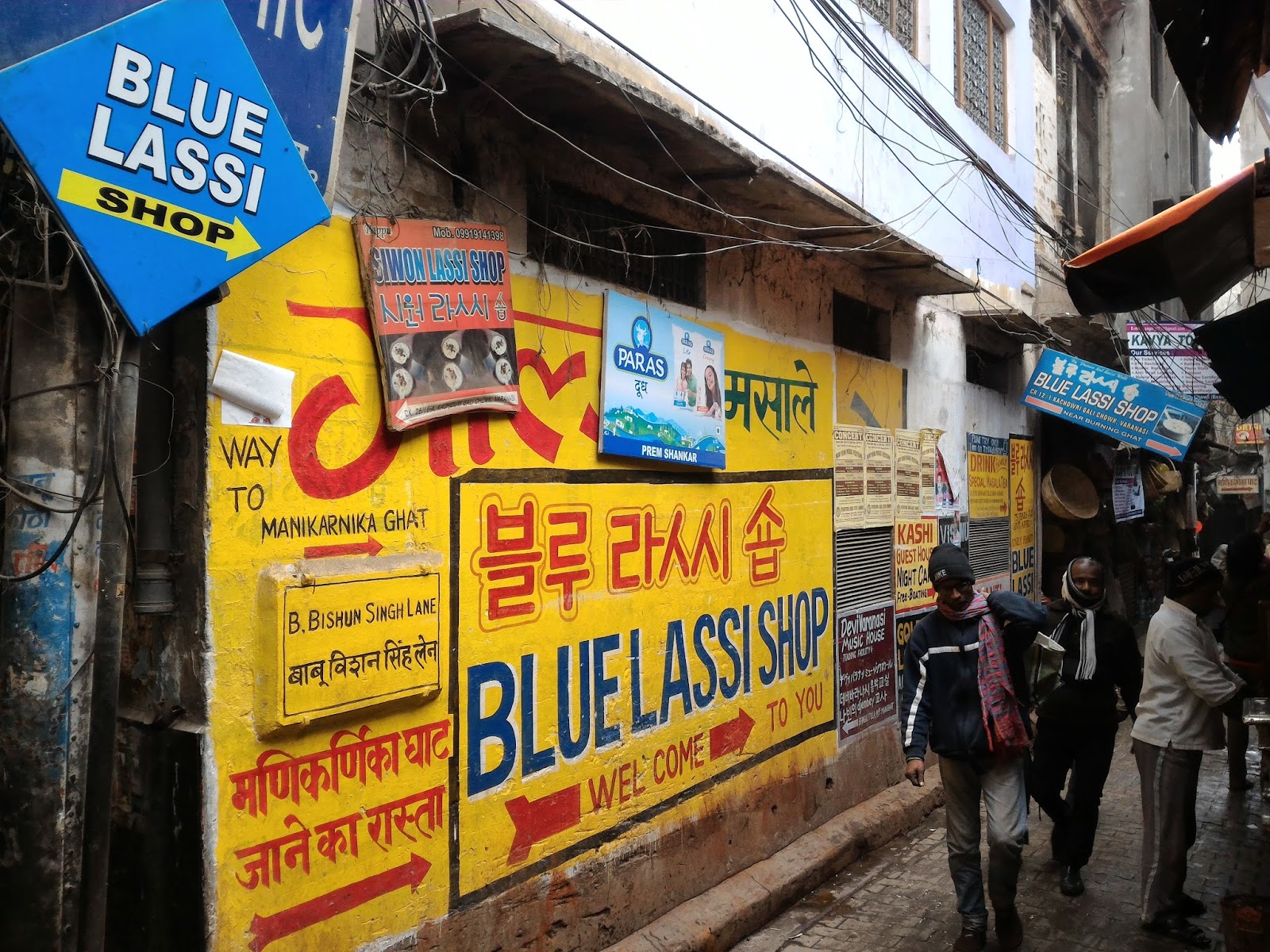
Tucked away on a narrow serpentine lane branching out from the famous Kachouri Galli, and leading towards the Manikarnika Ghat, it’s almost impossible to locate the shop, had it not been for the bright paintings on the wall in blue and yellow announcing it’s existence. It’s not very far from the epicenter of Varanasi, the Godhuliya Chowk, and it’s less than 10 minutes walk from there.


The first look at the shop was rather jolting for me, as the size of the shop is nowhere near the size of reputation that precedes it. It’s a small place, with an open front where the ubiquitous steel jug and wooden stirrers are kept along with the large earthen pots containing the curd. Just beside the open space there is a low doorway to enter the shop. I tucked my head in and went into the dimly lit interior. It had no window, excepting a curtained door at the back, which I presume leads to the living quarters of the house. Even in the broad daylight it was almost dark inside and I started taking a better look as my vision slowly started getting adjusted to the darkness. True to the name the walls were painted in shade of blue, bordering on Garish, and also deep shades of green along with motifs and faces of Gods & Goddesses. But the most interesting part is the thousands of small stamp sized photos and small paper chits along with it that are pasted all over the four walls. This is an amazing array and basically these are photos of people who had visited this shop and liked their lassi. They have a custom of collecting the photos. If you like their lassi you can also share your photo which will be put up on the wall. You can also leave a small note of appreciation which will also be struck on the wall. So it was a mini world within those four walls of that small dark room. You get to see photos of people from around the world along with notes written in various languages starting from Indian languages to English, Spanish, French, German, Korean, Japanese and as far as from South American Countries. This gives you an immediate idea how popular this lassi shop is among foreigners visiting Varanasi. In fact while we were there all other customers were Europeans and a few from south east Asian countries.

 The interior of the shop with photos and notes from all over the world 

Message from Chile

In fact the there is a history attached to this shop including how this shop got it’s rather unusual name. Blue Lassi shop wasn’t ‘Blue’ even twenty years back. It was just a humble lassi shop probably known by the name of it’s owner. Some seventy five years back Pannalal Yadav, started the lassi shop on the ground floor of his house on the narrow lane leading to Manikarnika Ghat. It didn’t have any fanfare but honest to goodness quality which is being maintained till date. It was known as Pannalal Yadav’s lassi shop. Slowly the shop started gaining popularity and it was being frequented by the foreigners. Varanasi, being the holy city for Hindus and also a centre for Buddhism because of it’s proximity to Sarnath, is frequented by foreign tourists round the year and they found this shop to be a nice joint to hang out. Unlike other roadside shops in Varanasi, which also sells very good lassi, this shop has a small seating arrangement inside which could have found favour with them. May be it also had a locational advantage being right on the lane leading to famous Manikarnika Ghat. Anyway the business flourished and Pannalal Yadav had become quite a known name. There is a photograph of him hung on the rear wall of the shop. This gentleman was more than just a ‘lassiwala’ and even acted in few movies. Vijay Yadav, his son and the current owner tells us about his father’s dabbling with movies and there is a Bengali connection. His first stint before the camera was with none other than the maestro Satyajit Ray, while he was shooting ‘Joy Baba Felunath’ at Varanasi. Pannalal Yadav acted as a villain in the gang of notorious crimelord ‘Maganlal Meghraj’ made immortal by Utpal Dutt. He had further acted in ‘Sant Tulsidas’ and the Sunny Deo starrer action movie ‘Ghayel’.

Vijay Yadav, whose picture you can see here, making lassi, joined the family business some 45 years back and I guess he was pretty young at that time. Since then he had been making lassi with his own hand maintaining the same legacy of quality. His son went to college and after getting his degree he also got involved in the family business. The change came some 20 years back when a team of Korean nationals who were obviously smitten by the quality of the lassi suggested that shop should be named ‘Blue Lassi Shop’. Do not ask me why this name, even Vijay Yadav is clueless. I take a wild guess that the interior of the shop would have been painted in blue, thus the name. Anyway it acted like a lucky charm and soon the name became very popular. So much so was the Korean influence that the name ‘Blue Lassi Shop’ is written in both English and Korean on the walls. Another important thing happened at the same time. Vijay Yadav’s son did some smart thinking and with steady experimentation brought variety to the humble lassi by adding fruits and flavors. This transformed the business further and the name spread quickly for the USP they were offering. Today they sell about 90 different types of flavored lassi. Most are punched with fresh seasonal fruits (a la natural ice cream)and flavours like chocolate & strawberry.

 Vijay Yadav busy preparing lassi

Now this is being poured for serving

Garnishing done. Cocoa powder being added for chocolate flavor

We had decided to try out different flavors and orders started with chocolate and punched with fruits like strawberry, apple, banana & shredded coconut. There is no machine involved it’s still hand churned with a wooden stirrer in an aluminium pot. The quality of the curd is outstanding and thick lassi that is produced literally need to be scooped out with spoon from the earthen cup in which they are served. One such portion, though looks small, can be quite filling and enough to douse the pangs of hunger. All the flavors, punched with fresh fruits, cocoa powders, strawberry flavors tasted great. We had lassi from other places in Varanasi but this one was unique experience.

 Almost ready for serving

 The seven different flavors in all their glory

Here is the close up view

The price is bit on the steeper side, an average flavoured lassi will set you back for more than sixty rupees. But the quality and taste more than make up for the price. You can see the handwritten chit in the photograph which was given to us a bill, and this will give you an idea of the prices.

The Bill.

The environment is also unique, while having lassi, you can see, hear and feel the throbbing , pulsating spirit of Varanasi all around you. The narrow lane, jostling crowd, interlaced with cycles, motorcycles, blaring horns, the cacophony and ubiquitous bulls & cows, all will overwhelm your senses. If you wait long enough you will hear the chanting of ‘Ram Nam Satya Hai’ and dead bodies will be carried past you towards the Manikarnika, the eternal burning ghat, as you are sipping your lassi.

This is something unique which can only be experienced in Varanasi, the oldest and holiest of them all. And yes Varanasi has grown on me in just two days. I will come back here and Blue Lassi Shop shall remain on my must visit list.